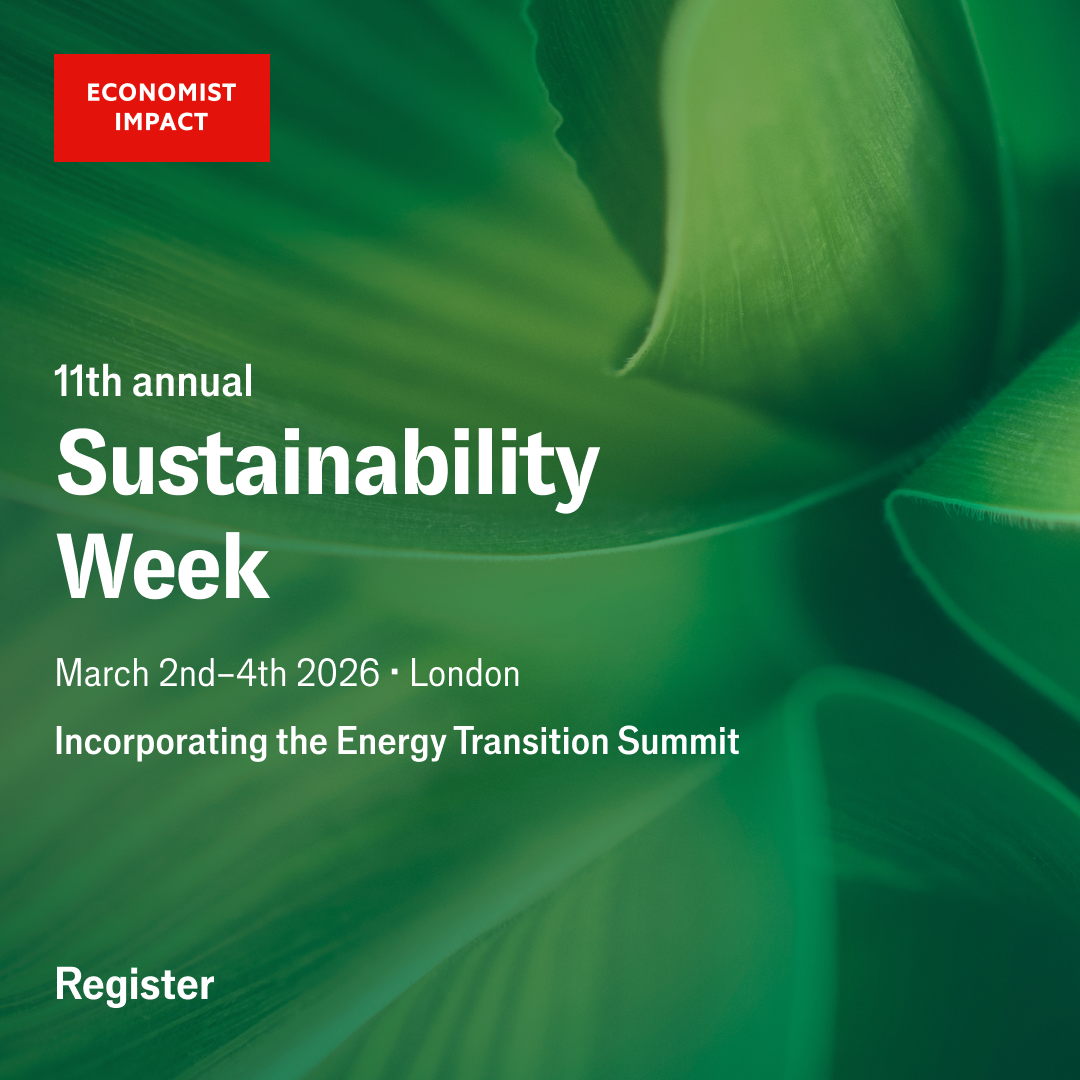
11th annual Sustainability Week 2026 | invitation

March 2nd-4th 2026
09:00 AM GMT
Intercontinental London – the O2

Event website
Registration

Use code MPP-SW20 for a discount on the pass.

We’re pleased to be part of Economist Impact’s 11th annual Sustainability Week—an event featuring hard-hitting and thought-provoking discussions designed to help navigate accelerating regulation, unlock new growth opportunities, and remain competitive in a rapidly transforming global economy.

With more than 400 speakers, 2,500 in-person attendees, 80 case studies, the 11th annual Sustainability Week tackles sustainability-related business challenges, finds solutions and gets results. Meet the most influential industry leaders, policymakers and innovators.

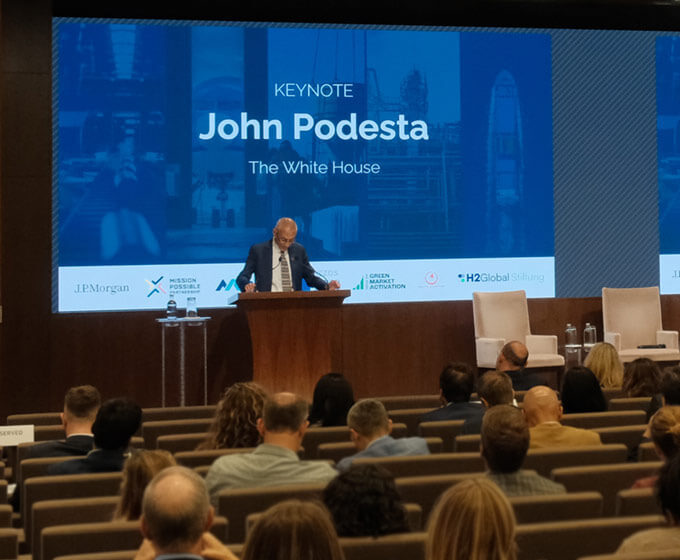
Comments from keynote speaker John Podesta Senior Advisor to the US President for International Climate Policy at the inaugural NYCW Green Markets Day 2024

“Thank you for that introduction. I want to acknowledge Dave Turk the Deputy Secretary of Energy, and JP Morgan Chase.

Thank you to the Bezos Earth Fund – and all of today’s partners for putting together this event and shining a light on the critical topic of green markets.

I don’t think I have to remind anyone this meeting is well timed.

We are at the end of a summer defined by the climate crisis.

July 22nd was the hottest day ever recorded by humans on this planet.

The consequences are all around us just last week, a storm dumped 18 inches of rain in the Carolinas torrential rains and floods killed more than 1,000 and displaced hundreds of thousands more in central and west Africa. Fires are right now ravaging Brazil, Bolivia, Ecuador, Peru, Colombia, and Uruguay. Typhoon Yagi killed more than 500 in Southeast Asia.

These tragedies and disasters also directly impact your businesses.

They are the evidence of what we are dealing with today

For example, drought in central America led to the lowest water levels in the Panama Canal in half a century which disrupted global shipping routes and supply chains.

Unprecedented floods in central Europe wiped out bridges and trucking routes.

More than 100 consecutive days of temperatures over 100-degree Fahrenheit in Phoenix put workers and businesses at risk.

To combat these threats, President Biden and Vice President Harris have pursued the most ambitious and successful climate agenda in history – one that is government-enabled, but private-sector led.

Through the Inflation Reduction Act, the largest investment in climate in history, we’ve provided ten-plus years of certainty through expanded and enhanced clean energy tax credits signaling to businesses that they can think big and make long-term decisions.

The private sector – and many of the companies in this room – has responded with more than $270 billion of investment just since the IRA passed more than 415 billion since President Bien and Vice President Harris took office and created more than 330,000 jobs.

We are making significant progress—but it’s time to focus on every aspect of decarbonization.

To achieve our goals to avoid the worst consequences of the climate crisis to bring solutions to market, at speed and at scale we need to address the emissions from heavy industry and long-distance transport.

It’s pretty simple math. These industries are responsible for roughly 30% of global emissions.

We will not meet our goals unless we reduce emissions in these sectors.

But right now, green industrial projects are not coming to the market quickly enough. And we continue to hear that there are struggles with liquidity in some of these markets.

Look at the consequences.

Just a few weeks ago, Orsted scrapped plans for their Flagship One green fuel plant in Sweden.

Lower carbon cement is moving forward but the most ambitious projects to drastically cut emissions are having trouble finding offtake.

I hope you are asking: how can this be?

We know that by 2030, companies like Ford, General Motors, and Volvo have committed that 10% of the steel they purchase will be net zero emissions.

We know that by 2030, Airbus, United, and Delta – just to name a few – have committed that up to 10% of the aviation fuel they buy will be the cleanest on the market.

And we know the Inflation Reduction Act in the United States the Clean Investment Tax Credits in Canada and the EU Innovation Fund and GX in Japan are fundamentally shifting the business case for green commodities.

The demand is there. The purchasers are there. Many of them are in this room. So, what needs to happen?

That’s what I want to focus on today.

One of the most important missing links across green commodities are book and claim systems, or systems that decouple greenhouse gas emissions reductions from physical goods and sell them separately.

Done right, book and claim can uncouple production credits from tradeable goods.

In other words, this detaches the “green attributes” that buyers want to pay for from the physical good being produced.

Consider a corporation that committed to buy green cement – a highly localized good.

They are willing to pay some extra amount for this cement because it is green.

And yet, depending on where this corporation is located, they may not be able to buy from a new decarbonized cement plant without additional and untenable transport costs.

Consider an airline that has agreed to purchase SAF, but finds that the fuel is set to be produced far away from their most popular travel routes.

Or consider an automaker that has committed to purchase green steel but buys steel from an intermediary, not directly from the green steel producer.

In all of these cases, there are willing buyers who want to decarbonize their operations.

They are willing to pay some premium for a decarbonized good within their value chain.

And yet, there is inefficiency that comes merely from the physical asset itself.

We need to help connect the willing capital for green goods with the projects that are making them.

Book and claim systems can help solve this problem.

They would allow purchasers to directly pay the price premium of green commodities – whether or not they are the direct purchaser of that good, and whether or not that is the exact unit of cement or concrete or steel or fuel that will be used in their own operations.

Of course, we want them to take this delivery of green commodities where they can and overtime that will become easier if we increase liquidity in the market now.

Overnight, this would increase liquidity innovative green products would finally have access to the capital they need.

In addition, once sold, the good itself would enter the commodity market.

And finally, this creates a straightforward way for corporations to directly impact their emissions and clean up their own operations.

This creates a straightforward way for corporations to impact their emissions something that we hear and time and time again is a serious challenge for companies currently looking to clean up their supply chains.

So, what do these book and claim systems need to look like?
We aren’t reinventing the wheel.

We can draw on lessons learned in the United States with Renewable Energy Certificates.

There, we have made progress to create a market-based instrument that separates out the attributes of renewable energy, allowing us to better track account for and pay for green electricity nationwide.

I know many private sector and NGO groups in this room today have worked hard to build out these registries – thank you for your work.

Going forward, for each of the “hardest to abate” industries the private sector needs to develop transparent, trusted, and verifiable registries.

These systems must be transparent if they are to be trusted.
These systems must be third-party verified with established certification processes if they are to be reliable.

And these systems must be underpinned by auditable registries if they are to be durable.

I’ve often wondered why God created blockchain. I worried it was for crypto grifters but maybe book and claim is the answer!

In some ways, I see parallels between the need for book & claim systems, and the need for voluntary carbon markets.

In May, the administration released principles in voluntary carbon markets, similar to the guidelines I just outlined.

Like the voluntary carbon markets, book & claim systems are another solution that will help us to crowd in private capital and deliver reliable revenue streams.

And like voluntary carbon markets, if we don’t set strong standards—we risk seeing more greenwashing than we do greening of industries.

Overall, we know the formation of new markets is complicated, and will require a great deal of coordination among your companies, national governments, and international bodies.

We know book and claim systems are not the only barrier to scaling green industry.

We also have to address product standards regulations permitting cost of capital and contracting mechanisms.

This will not be easy but what the successes of the past four years have shown us is: we can do this.

We just need to be honest about where we are and ambitious about how to accelerate our progress. We need to work pragmatically, and across stakeholders, to kick-start markets.

So that is my ask for each of you today and going forward.
Engage urgently on this work.

The right people are here in this room today. So, talk to each other.

Figure out who is not in this room and bring them into this conversation.

And after this week, talk to your boardrooms and C-suite colleagues and explain why this is critical – not just for the global climate fight, but for your bottom lines.

President Biden and Vice President Harris did their part: again, our strategy is government-enabled, but private sector led.

We made unprecedented government investment in these technologies.

Now the private sector needs to take this progress and run with it.

Together, let’s get this done.”

London Climate Action Week 2025 | highlights

In June, the MPP team participated to the annual London Climate Action Week, where they attended key events and contributed to panel discussions and roundtables.

New engines of growth: frontrunners in a clean industrial race

Mission Possible Partnership (MPP) and Oliver Wyman co-hosted an interactive breakfast among 30 industry, policy and finance leaders, examining the “Bright Spots” of projects in the clean industrial landscape, and exploring new data and insights from MPP’s Global Project Tracker.

Looking at the state of the clean industrial pipeline today, this event examined new data and discussed clean industry transformation global trends from MPP’s Global Project Tracker (released days earlier, on 19 June).  We heard directly from project developers on finding solutions to challenges and improving bankability for large-scale clean industrial projects.

MPP’s CEO, Faustine Delasalle give a personal reflection on LCAW and the progress of clean industry

“Since the beginning of the year, we have been living through a whirlwind of global geopolitical and economic changes. The last few weeks were no exception, with military conflicts, tariffs, and heatwaves making headlines. It takes a good dose of stubborn optimism to keep seeing and seizing opportunities in that storm. But I reach the mid-year point confident that these opportunities exist, including in clean industry.

It’s one year on from the publication of our first Global Project Tracker and with the latest update we can see that clean industry transformation is on the way – the ‘new industrial sunbelt’ (more on this below) is driving a diversification of industrial centres across the globe and the pipeline of commercial-scale, clean industrial projects is rapidly expanding. If every project in it were to go into operation that would mean a reduction of around 1 Gt of CO2 emissions per year. It would also unlock $1.6 tn of investment, with more than half flowing in emerging markets and developing economies, open-up new win-win trade relationships between regions with different competitive strengths, and in turn would bring huge socio-economic benefits.

Hot on the heels of our report, London Climate Action Week kicked off, more packed than usual. Three things stood out for me throughout the week:

  • ‘We mean business’ is not just the name of one of MPP’s close partners, who powerfully brings the voice of leading businesses on the climate agenda since the Paris Agreement. It’s the narrative that is rightly gaining traction: investing in the energy and industry transition yields short-term economic benefits and long-term competitiveness. In that quest to demonstrate the bankability of clean technologies though, we shouldn’t lose track of the most fundamental business case: the climate breakdown will yield an economic breakdown, hitting vulnerable communities first, and that’s reason enough to invest in climate solutions, even those that entail an upfront cost
  • What the world needs at this juncture is action-focused discussions on how to drive progress in the real economy now. I was pleasantly surprised that most sessions throughout the week were precisely thought through to enable such exchanges on the ‘how’, seeding collaborations between companies, financiers, government interlocutors, and civil society organisations. I was delighted to be able to share the learnings from our team’s work with project developers on the ground from Brazil to Australia on how to most effectively accelerate final investment decisions for clean industrial projects, including through value chain partnerships, demand-stimulation policies, and market derisking
  • Spotting and seizing opportunities to speed up action on climate and nature can often feel like a relentless job in 2025. But we can tap into a growing source of renewable energy and optimism: the community of brilliant practitioners from a vast array of backgrounds and organisations who are wholeheartedly committed to this mission. In London, I was grateful for the opportunity to listen to, exchange with, and learn from many new and old fellow travellers who are bringing a myriad of solutions to life. As we go back to our day jobs – possibly after a holiday break – let’s not forget that this collaborative spirit is not just a wonderful mood-booster to be enjoyed at LCAW and NYCW, but an essential behaviour to drive effective action year-round”

Faustine Delasalle
CEO Mission Possible Partnership I Executive Director Industrial Transition Accelerator

11th annual Sustainability Week 2026 | invitation

March 2nd-4th 2026
09:00 AM GMT
Intercontinental London – the O2

Event website
Registration

Use code MPP-SW20 for a discount on the pass.

We’re pleased to be part of Economist Impact’s 11th annual Sustainability Week—an event featuring hard-hitting and thought-provoking discussions designed to help navigate accelerating regulation, unlock new growth opportunities, and remain competitive in a rapidly transforming global economy.

With more than 400 speakers, 2,500 in-person attendees, 80 case studies, the 11th annual Sustainability Week tackles sustainability-related business challenges, finds solutions and gets results. Meet the most influential industry leaders, policymakers and innovators.

London Climate Action Week 2025 | highlights

In June, the MPP team participated to the annual London Climate Action Week, where they attended key events and contributed to panel discussions and roundtables.

New engines of growth: frontrunners in a clean industrial race

Mission Possible Partnership (MPP) and Oliver Wyman co-hosted an interactive breakfast among 30 industry, policy and finance leaders, examining the “Bright Spots” of projects in the clean industrial landscape, and exploring new data and insights from MPP’s Global Project Tracker.

Looking at the state of the clean industrial pipeline today, this event examined new data and discussed clean industry transformation global trends from MPP’s Global Project Tracker (released days earlier, on 19 June).  We heard directly from project developers on finding solutions to challenges and improving bankability for large-scale clean industrial projects.

MPP’s CEO, Faustine Delasalle give a personal reflection on LCAW and the progress of clean industry

“Since the beginning of the year, we have been living through a whirlwind of global geopolitical and economic changes. The last few weeks were no exception, with military conflicts, tariffs, and heatwaves making headlines. It takes a good dose of stubborn optimism to keep seeing and seizing opportunities in that storm. But I reach the mid-year point confident that these opportunities exist, including in clean industry.

It’s one year on from the publication of our first Global Project Tracker and with the latest update we can see that clean industry transformation is on the way – the ‘new industrial sunbelt’ (more on this below) is driving a diversification of industrial centres across the globe and the pipeline of commercial-scale, clean industrial projects is rapidly expanding. If every project in it were to go into operation that would mean a reduction of around 1 Gt of CO2 emissions per year. It would also unlock $1.6 tn of investment, with more than half flowing in emerging markets and developing economies, open-up new win-win trade relationships between regions with different competitive strengths, and in turn would bring huge socio-economic benefits.

Hot on the heels of our report, London Climate Action Week kicked off, more packed than usual. Three things stood out for me throughout the week:

  • ‘We mean business’ is not just the name of one of MPP’s close partners, who powerfully brings the voice of leading businesses on the climate agenda since the Paris Agreement. It’s the narrative that is rightly gaining traction: investing in the energy and industry transition yields short-term economic benefits and long-term competitiveness. In that quest to demonstrate the bankability of clean technologies though, we shouldn’t lose track of the most fundamental business case: the climate breakdown will yield an economic breakdown, hitting vulnerable communities first, and that’s reason enough to invest in climate solutions, even those that entail an upfront cost
  • What the world needs at this juncture is action-focused discussions on how to drive progress in the real economy now. I was pleasantly surprised that most sessions throughout the week were precisely thought through to enable such exchanges on the ‘how’, seeding collaborations between companies, financiers, government interlocutors, and civil society organisations. I was delighted to be able to share the learnings from our team’s work with project developers on the ground from Brazil to Australia on how to most effectively accelerate final investment decisions for clean industrial projects, including through value chain partnerships, demand-stimulation policies, and market derisking
  • Spotting and seizing opportunities to speed up action on climate and nature can often feel like a relentless job in 2025. But we can tap into a growing source of renewable energy and optimism: the community of brilliant practitioners from a vast array of backgrounds and organisations who are wholeheartedly committed to this mission. In London, I was grateful for the opportunity to listen to, exchange with, and learn from many new and old fellow travellers who are bringing a myriad of solutions to life. As we go back to our day jobs – possibly after a holiday break – let’s not forget that this collaborative spirit is not just a wonderful mood-booster to be enjoyed at LCAW and NYCW, but an essential behaviour to drive effective action year-round”

Faustine Delasalle
CEO Mission Possible Partnership I Executive Director Industrial Transition Accelerator

Global Impact

Campaigns

GLOBAL PLATFORM

TRACKING PROGRESS